

From Software Curiosity to Chip Discovery: Meet Pierre at Texplained

Meet Pierre at Texplained
Pierre joined the team as an apprentice software developer with a strong passion and a desire to keep learning. At just 18 years old, he had already been exploring software development for five years. Today, he contributes to ChipJuice, Texplained’s data extraction & analysis software, where he works on algorithms designed to help decode complex semiconductor data.
But his journey into hardware reverse engineering did not begin with experience in the field. It began with something much simpler: curiosity.
Working in a team of Hackers
Pierre is currently completing a Bachelor in Computer Science through an apprenticeship program, combining academic learning with hands-on experience in the company. That balance between theory and practice suited him well, especially in a field as demanding and stimulating as software development.
What drew him to development in the first place was not just the act of coding, but the way it constantly challenges the mind.
As he explains:
“Development feeds both curiosity and logic. It’s intellectually stimulating, and you learn something new every day.”
He was looking for more than a routine role. He wanted a field in which he could continue solving problems, and expanding his understanding over time. For Pierre, the thought of stagnating was the opposite of what he wanted from work.
When he discovered Texplained, one line in the job offer immediately caught his attention:
“Work in a team of hackers.”
For Pierre, that was exactly the kind of environment he wanted to be part of.
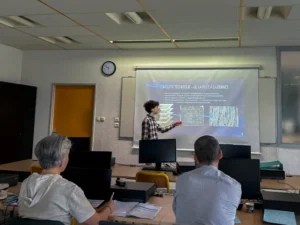
Discovering a field far beyond software alone
One of the first things that surprised Pierre about hardware reverse engineering was that chemistry plays such an important role in the process. A large part of the work happens in Le Lab before any meaningful data reaches a computer.
As he puts it:
“I didn’t imagine so many steps were required before reaching the data.”
That discovery changed his perspective. Reverse engineering a chip is not only about digital analysis or software tools. It also involves physical preparation, scientific rigor, and a sequence of technical steps that must be carried out with precision long before the algorithmic phase begins.
He was also struck by the scale of the work itself. At Texplained, we analyze structures and images at the nanometer level. That means dealing with forms of data that are both visually fascinating and technically demanding. It is a world where tiny physical details can carry enormous significance.
However, Pierre had the opportunity to expand his understanding of hardware through Texplained’s Online Training courses. He learned about topics such as digital electronics, deprocessing, image processing, and netlist extraction. These self-paced modules helped him build a stronger foundation in reverse engineering and better understand hardware at the transistor level.
Step by step, he moved from knowing nothing about the field to understanding how components interact and how the “magic” happens within a chip. That evolution is significant, not only in terms of knowledge, but also in the way it reshapes a developer’s perspective. For someone coming from a software-focused background, it was a powerful introduction to the complexity of the semiconductor world.
That broader view can change the way problems are approached and solved.
From data to algorithms on ChipJuice
Today, Pierre works on the algorithmic sides of ChipJuice.
His role involves developing code that performs calculations to solve logical problems tied to semiconductor analysis. This is one of the aspects that makes working at Texplained so distinctive for a developer. The challenge is not limited to building standard software features. It is about designing reliable tools that can support complex reverse engineering tasks on highly specialized data.
Pierre describes the difference clearly:
“Where some developers manipulate databases, we work with images of integrated circuits measured in nanometers.”
That contrast says a lot about the nature of ChipJuice and the environment in which it is built. Instead of conventional business data, the software must handle massive datasets derived from semiconductor imagery and chip structures. This requires an approach grounded in precision, scalability, and robustness.
For developers like Pierre, contributing to it means working at the intersection of logic, mathematics, user needs, and advanced semiconductor investigation.
His advice to future developers
When asked what advice he would give to students interested in this domain, Pierre keeps it simple:
“Stay curious. Not only about the newest technologies, but also about the older ones. Understanding how systems evolved often provides insights that are still valuable today.”
That mindset reflects something essential in both software development and hardware reverse engineering. Innovation does not happen in isolation. It often comes from understanding what came before, why systems were designed the way they were, and how past technologies continue to shape current ones.
Pierre also offers a message that speaks directly to software developers:
“Don’t ignore the hardware.”
It is a simple sentence, but it carries real weight. The deeper you understand the full system, the more relevant, efficient, and powerful your solutions can become. For developers working on advanced tools like ChipJuice, that depth of understanding can make all the difference.
Why Pierre’s journey reflects Texplained’s spirit
Pierre’s story is a reminder that expertise does not always begin with prior knowledge. Sometimes, it begins with the right mindset.
A passion for software. A taste for logic. A willingness to learn. A fascination for understanding systems deeply. These are the qualities that allowed him to move from software curiosity to hardware discovery, and to contribute today to a platform like ChipJuice.
At Texplained, that journey matters because it reflects how innovation really happens: through people who are ready to explore beyond what they already know.
Whether through advanced reverse engineering projects, software development, or specialized learning opportunities, curiosity remains at the core of the work. And for those who want to keep pushing their understanding further, our training courses are part of that same philosophy: learning deeply, thinking critically, and understanding technology from the inside out.